




Last updated: July 2026
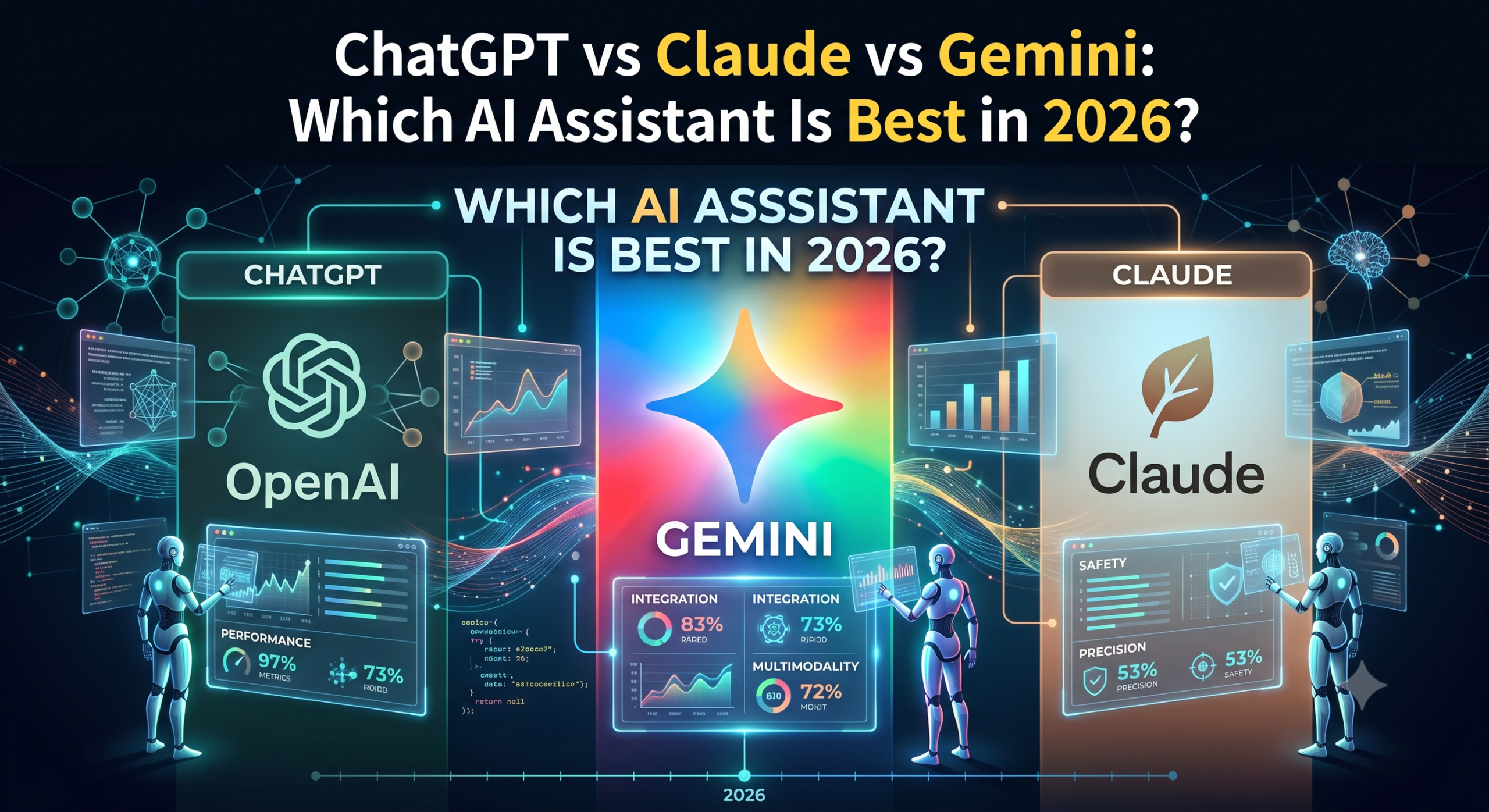
If you’ve typed “ChatGPT vs Claude vs Gemini” into Google in the last few months, you already know the problem: every article says “it depends,” gives you a vague chart, and sends you on your way. That’s not helpful when you’re trying to decide which $20-a-month subscription (or which free app) actually deserves a spot on your phone’s home screen.
This guide is different. We tested all three assistants side by side on real, everyday tasks — writing emails, debugging code, planning a trip, summarizing a PDF, and even asking dumb questions at 1 a.m. — and we’re giving you a straight answer for each category, not a shrug.
Quick Summary
- Best overall for most people: ChatGPT — the most versatile, the biggest ecosystem, and still the app most Americans already have installed.
- Best for writing, coding, and long documents: Claude — cleaner prose, fewer made-up facts, and the strongest performance on real coding benchmarks.
- Best for Google users and real-time research: Gemini — built into Gmail, Docs, and Search, with the largest context window of the three.
- Cheapest way in: All three now sit around $20/month for their main paid tier, but Gemini’s entry-level paid plan and ChatGPT Go undercut that for budget-conscious users.
- Best free tier: Gemini, thanks to deep Google integration even without a subscription.
If you only read one section, read the comparison table below. If you want the full breakdown — pros, cons, pricing, and who should pick what — keep scrolling.
Table of Contents
- What Are ChatGPT, Claude, and Gemini?
- Side-by-Side Comparison Table
- Writing and Content Creation
- Coding and Software Development
- Research, Search, and Real-Time Information
- Multimodal Skills: Images, Voice, and Video
- Privacy, Data Training, and Security
- Pricing: Free vs. Paid Plans Compared
- Pros and Cons of Each Tool
- Best Use Cases: Who Should Use Which Tool
- Lesser-Known Facts Most Users Don’t Know
- Real User Feedback and Social Proof
- Frequently Asked Questions
- Final Verdict
- Sources
1. What Are ChatGPT, Claude, and Gemini?
Before comparing them head-to-head, here’s a plain-English refresher on what each tool actually is and who’s behind it.
ChatGPT is OpenAI’s chatbot, the one that kicked off the whole AI assistant boom back in late 2022. It’s now on its GPT-5.5 model family, with a free tier, a $20/month Plus plan, a budget-friendly Go tier, and higher-end Pro and Pro Max plans for power users. ChatGPT has the largest user base of any AI assistant in the world and the biggest ecosystem of plugins, custom GPTs, and third-party integrations.
Claude is made by Anthropic, a San Francisco-based AI safety company founded by former OpenAI researchers. Claude built its reputation on careful, well-reasoned writing and strong coding ability, and it’s become the go-to pick for developers and professional writers who need a tool that follows instructions precisely instead of improvising. Claude’s lineup includes free access, a Pro plan around $20/month, and higher Max tiers for heavy users and teams.
Gemini is Google’s AI assistant, woven directly into Gmail, Google Docs, Google Sheets, Android phones, and Google Search itself. If you already live inside Google Workspace, Gemini shows up automatically as a sidebar in your existing apps. Google offers a generous free tier and a Google AI Pro subscription that bundles extra storage and premium features across Google’s other products.
All three companies release new model versions every few months, so benchmarks shift constantly — but the core personality of each tool has stayed remarkably consistent: ChatGPT is the all-rounder, Claude is the careful craftsman, and Gemini is the connected researcher.
2. Side-by-Side Comparison Table for ChatGPT vs Claude vs Gemini
| Feature |
|
|
 |
|---|---|---|---|
| Company | OpenAI | Anthropic | |
| Free tier | Yes, limited messages every few hours | Yes, daily message cap | Yes, generous with Google account |
| Entry paid plan | Plus — $20/month | Pro — $20/month ($17/month billed annually) | Google AI Pro — $19.99/month |
| Budget plan | ChatGPT Go — around $8/month | Not offered | Google AI Plus — under $5/month |
| Context window (approx.) | Large, up to roughly 1M tokens on flagship tier | Large, with some plans offering extended context | Largest of the three, up to 1M+ tokens |
| Best at | General versatility, image generation, voice mode | Writing quality, coding, long documents | Research, Google integration, multimodal tasks |
| Built-in web search | Yes | Limited/varies by plan | Yes, deeply tied to Google Search |
| Native app integrations | Broadest plugin/GPT ecosystem | Fewer built-in integrations, strong API | Gmail, Docs, Sheets, Android, Chrome |
| Image generation | Yes, strong | No native image generation | Yes, strong |
| Voice mode | Yes, advanced | Limited | Yes, Gemini Live |
| Data training default | Opt-out required in settings | Off by default unless you opt in | Opt-out required (turn off Activity) |
| Coding strength | Strong, improving fast | Consistently rated top-tier by developers | Solid, trailing on complex codebases |


Prices and specs change often, so always check each company’s official pricing page before subscribing — links are in the Sources section below.
3. Writing and Content Creation
If you write for a living — blog posts, emails, scripts, marketing copy — this is probably the category you care about most.
Claude consistently produces the most natural-sounding prose of the three. It follows style instructions closely, avoids repetitive sentence structures, and doesn’t lean as hard on the same handful of overused phrases that make AI writing easy to spot. Several independent writers and marketing teams have noted that Claude’s LinkedIn posts and long-form drafts read less “robotic” out of the box, which means less editing afterward.
ChatGPT is close behind and genuinely excels at brainstorming, outlining, and adapting tone quickly across a conversation. It’s especially strong at pulling in relatable examples and case studies, which makes it handy for marketing copy that needs a human touch.
Gemini writes competently and is a strong choice when your content needs to be grounded in current, searchable facts, but it tends toward wordier output with more bullet points than either competitor, so expect to trim.
Bottom line: For polished long-form writing, pick Claude. For fast brainstorming and varied tone, ChatGPT holds its own.
4. Coding and Software Development
This is the category with the clearest gap between the three tools.
Claude is the developer favorite right now. It handles full-file refactors, understands large codebases, and makes noticeably fewer logic errors on complex, multi-step programming tasks. It also comes bundled with Claude Code, a command-line coding agent that a large share of professional developers have adopted for real production work.
ChatGPT remains excellent for quick scripts, one-off functions, and data analysis thanks to its built-in code execution tools, and it has strong IDE plugin support through Codex-style extensions.
Gemini has improved significantly and handles everyday coding tasks fine, but independent benchmark testing still shows it trailing the other two on the toughest, real-world coding challenges.
Bottom line: If code quality is your top priority, Claude wins clearly. If you want quick snippets inside a familiar chat window, ChatGPT is perfectly capable.
5. Research, Search, and Real-Time Information
Gemini has the built-in advantage here because it’s tied directly to Google Search. Ask it about something that happened this morning, and it can pull live results without missing a beat — a natural fit for anyone doing market research, news monitoring, or fact-checking.
ChatGPT also browses the web well and has closed much of the gap, with solid citation habits and a mature web-search feature.
Claude can search the web too, but its real strength in research is digesting long documents you upload yourself — contracts, research papers, financial reports — rather than pulling fresh information from the open internet.
Bottom line: For live, up-to-the-minute research, Gemini edges ahead. For analyzing documents you already have, Claude is the stronger pick.
6. Multimodal Skills: Images, Voice, and Video
If you need an AI that can generate images, understand photos, or hold a spoken conversation, ChatGPT and Gemini are the two real contenders. ChatGPT’s voice mode and image generation are polished and widely used, while Gemini Live offers similarly strong voice conversation and leans on Google’s strength in photo and video understanding, especially for Android users.
Claude does not currently offer native image generation and has more limited voice and audio capabilities, so if your workflow depends heavily on visuals or spoken interaction, it’s not the natural first choice.
7. Privacy, Data Training, and Security
Data privacy is one of the most misunderstood parts of this comparison, and it’s genuinely different across the three.
- ChatGPT trains on your conversations by default unless you manually turn this off in Settings > Data Controls.
- Gemini also uses your activity by default unless you turn off “Keep Activity” in your Google account settings.
- Claude stands out here: by default, Anthropic does not train on your conversations unless you explicitly opt in, and it applies a standard 30-day data retention window for most users.
For anyone handling sensitive client data, legal documents, or proprietary business information, this difference matters more than most people realize — and it’s one of the quiet reasons law firms, healthcare companies, and financial teams increasingly lean toward Claude for internal use.8. Pricing: Free vs. Paid Plans Compared
Free Tier Benefits
| Tool | What you get for free |
|---|---|
| ChatGPT | Limited messages on the flagship model every few hours, image analysis, file uploads, and basic web browsing |
| Claude | Access to a capable model with a daily/weekly message cap, strong for writing and analysis in shorter sessions |
| Gemini | Generous usage tied to your Google account, Search integration, image generation, and Workspace access even without paying |
Paid Tier Benefits
| Tool | What paying unlocks |
|---|---|
| ChatGPT Plus (~$20/mo) | Higher message limits, the top-tier model, image generation, voice mode, and access to custom GPTs |
| Claude Pro (~$20/mo, cheaper annually) | Much higher usage caps, extended thinking for harder problems, and Projects for organizing long-term work |
| Google AI Pro (~$20/mo) | Full access to Gemini’s top model, deeper Workspace integration, and bundled Google storage |
If budget is your main concern, look at ChatGPT Go and Google AI Plus — both offer a cheaper middle-ground tier below the full $20/month plans, which is worth knowing since most comparison articles only mention the flagship pricing.
9. Pros and Cons of Each Tool
ChatGPT
Pros: Most versatile all-in-one tool; largest plugin and integration ecosystem; strong image generation and voice mode; widest brand recognition and community support; frequent feature updates.
Cons: Data trains on your chats by default; free tier usage limits reset frequently and can feel restrictive; output can drift on very long, detailed, multi-part instructions.
Claude
Pros: Best-in-class writing quality with less “AI-sounding” filler; top-tier coding performance; privacy-friendly defaults; excellent for long document analysis; strong instruction-following on complex tasks.
Cons: No native image generation; more limited voice and multimodal features; smaller third-party integration ecosystem; fewer built-in real-time search capabilities compared to Gemini.
Gemini
Pros: Deep, seamless integration with Gmail, Docs, Sheets, and Android; strongest real-time search grounding; largest context window for handling huge documents; genuinely useful free tier.
Cons: Writing can be wordier and more bullet-point-heavy than competitors; trails on the toughest coding benchmarks; some features are most useful only if you’re already inside the Google ecosystem.
10. Best Use Cases: Who Should Use Which Tool
- Students and researchers: Gemini, for its Google Search grounding and Workspace tie-ins for essays and study notes; ChatGPT as a close second for study help and explanations.
- Software developers and engineering teams: Claude, especially paired with its command-line coding agent, for anything beyond quick snippets.
- Freelance writers, bloggers, and content marketers: Claude for polished drafts that need less editing; ChatGPT for fast brainstorming and varied tone across many pieces.
- Small business owners and marketers: ChatGPT, for its broad feature set covering copywriting, image creation, and customer-facing chat setup.
- Google Workspace-heavy teams (schools, nonprofits, small offices): Gemini, since it’s already built into tools they use daily.
- Legal, healthcare, and financial professionals: Claude, largely because of its privacy-first data defaults and strong document analysis.
- Casual, everyday users who just want one app: ChatGPT, simply because of its brand familiarity and the widest range of built-in features.
11. Lesser-Known Facts Most Users Don’t Know
- All three companies now update their flagship models every few months, so a “winner” in one benchmark round can shift within weeks — treat any single comparison as a snapshot, not a permanent ranking.
- ChatGPT’s free tier now shows sponsored suggestions to some users, something many people don’t expect from a chatbot.
- Claude’s default privacy setting (no training on your data unless you opt in) is genuinely different from the other two, and it’s rarely mentioned in casual comparisons.
- Switching between these tools does not transfer your saved chats, custom instructions, or “memory” — if you’re thinking about switching, export anything important first.
- Independent blind tests, where users vote without knowing which tool produced which answer, have repeatedly shown Claude winning a majority of writing and reasoning rounds — a sign that brand familiarity, not raw quality, drives a lot of ChatGPT’s popularity.
- Many power users don’t pick just one. It’s increasingly common to keep a ChatGPT subscription for everyday chat and voice, a Claude subscription for coding or serious writing, and Gemini’s free tier for quick research — since the free tiers on all three have become genuinely usable.
12. Real User Feedback and Social Proof
Independent blind testing has become one of the most trusted ways to judge these tools, precisely because it removes brand bias. In one recent community blind test covering eight different writing and reasoning prompts, Claude took the majority of rounds, Gemini came in second, and ChatGPT — despite being the most recognized name — won only a single round outright. Voters weren’t told which model produced which answer until after voting closed.
Enterprise IT teams echo similar patterns in their own internal evaluations: coding-focused teams gravitate toward Claude, general-purpose business teams lean on ChatGPT for its ecosystem, and Google Workspace organizations default to Gemini simply because it’s already sitting inside their existing subscription. The recurring theme across independent reviewers, marketing teams, and developer communities isn’t that one tool dominates everything — it’s that each has built a genuine, defensible advantage in a specific lane.
13. Frequently Asked Questions
Is ChatGPT, Claude, or Gemini better for beginners? ChatGPT is generally the easiest entry point simply because it’s the most widely used and has the most tutorials, guides, and community support available online.
Which AI assistant is completely free to use? All three offer usable free tiers. Gemini’s free tier is currently the most generous thanks to Google account integration, but ChatGPT and Claude both offer solid free access with daily or periodic message limits.
Can I use more than one AI assistant at the same time? Yes, and many professionals do exactly that — for example, Claude for coding and writing, ChatGPT for everyday tasks and voice mode, and Gemini for quick research tied to Google Search.
Which one is best for coding? Claude currently leads on independent coding benchmarks and is favored by a large share of professional developers, though ChatGPT remains a strong option for quick scripts and data analysis.
Does Claude, ChatGPT, or Gemini train on my personal data? Gemini and ChatGPT use your conversations for training by default unless you manually opt out in your account settings. Claude does not train on your conversations unless you choose to opt in.
Which tool is cheapest? Base pricing across all three sits near $20/month, but ChatGPT Go and Google AI Plus offer lower-cost tiers below that price point for budget-conscious users.
Which AI assistant is best for small businesses? It depends on your team’s existing tools: ChatGPT for general-purpose flexibility, Gemini if you already run on Google Workspace, and Claude if your work centers on writing, documents, or code quality.
14. Final Verdict
There isn’t one single “best” AI assistant — and honestly, anyone who tells you otherwise is oversimplifying. What’s true is that each tool has carved out a real, defensible strength: ChatGPT is the most versatile everyday companion, Claude is the sharpest writer and coder with the most privacy-friendly defaults, and Gemini is the smartest choice if your life already runs through Google.
The smartest move for most people in 2026 isn’t picking one and swearing loyalty to it — it’s trying all three free tiers, noticing which one actually fits how you work, and going from there. If you had to pick just one to pay for: choose based on what you do most often, not which name you’ve heard the most.
15. Sources
- OpenAI — Official ChatGPT Pricing
- Anthropic — Official Claude Pricing
- Google — Official Gemini App
- Google — Google One AI Premium Plans
- OpenAI — ChatGPT Help Center
- Anthropic — Claude Privacy and Data Usage
This article reflects publicly available information and independent testing as of July 2026. AI models, pricing, and features change frequently — always confirm current details on each company’s official website before subscribing.
